
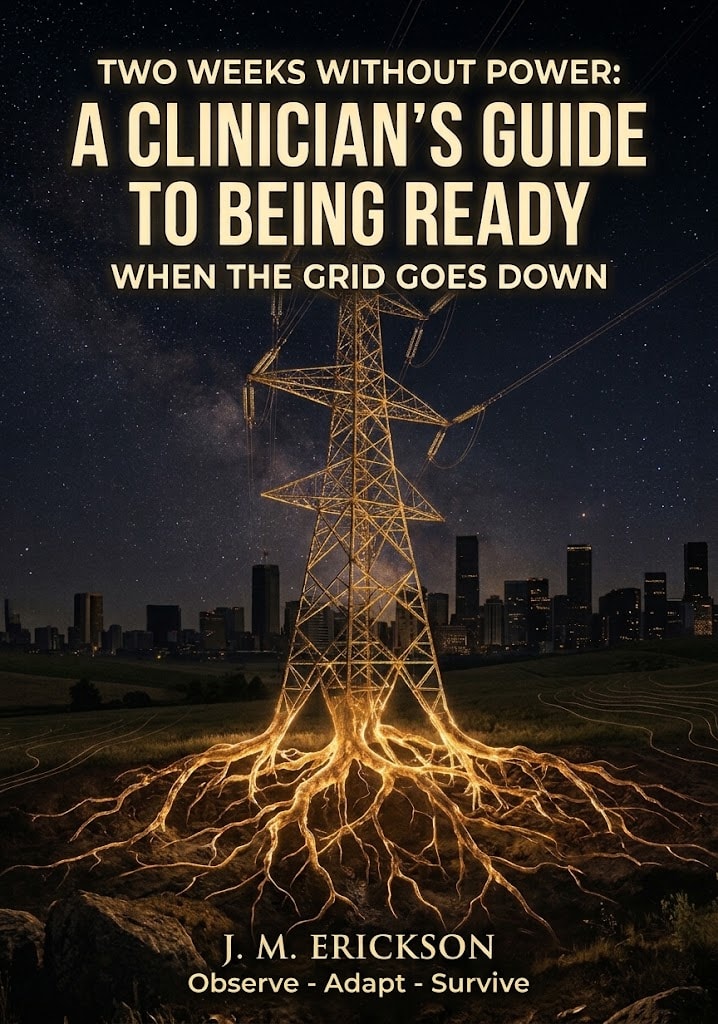
Two Weeks Without Power
A Clinician's Guide to Being Ready When the Grid Goes Down
FEMA recommends preparing for a fourteen-day power outage. Two weeks. Most American households would fail that test on the third day — not because two weeks is difficult, but because no one has ever assigned the tasks.
Four Requirements. Not a Gear List.
Everything else — storage, security, skills — is either a way of meeting these four requirements or a way of extending them past fourteen days.
Water, Food & Sanitation
Fourteen days without municipal supply — calculated, stored, and rotated.
Medication & Medical Equipment
Fourteen days of prescriptions and a written plan for day fifteen.
One Survivable Room
Heated or cooled to a safe temperature, with a way to cook.
Four to Six Neighbors
People who would answer the door at 2 a.m. Community is infrastructure.
What Makes It Different
Three things no other preparedness book offers — because no other preparedness book was written by a licensed clinician.
A clinician wrote it — and that changes the content, not just the tone
Other preparedness books tell you what to store. This one tells you what actually kills people first, in what order — including the clinical facts no gear list covers. Alcohol and benzodiazepine withdrawal can be fatal without medical management, and in a blackout there is none. Fear shuts down the frontal cortex, which is why untrained people make their worst decisions exactly when decisions matter most. And assessment is not profiling: the book gives households a way to judge conduct rather than categorize people, which is what keeps a group intact.
The standard is federal and measurable — you always know where you stand
Two weeks is FEMA's own shelter-in-place recommendation — the length of outage most households will actually face, and the point at which the refrigerator, the pipes, and the prescriptions all stop working at once. Everything in the book either meets those four requirements or extends them past fourteen days. There is no third job, and no vague advice about being 'better prepared.'
It is geographically specific where every other book is generic
Texas City, Texas and Uxbridge, Massachusetts run through the same fourteen-day framework at three days, ten days, thirty, and a year. A Gulf Coast reader faces lethal heat, humidity that ruins dressings, and petrochemical risk. A New England reader faces lethal cold, frozen pipes, and the cardiac events that follow a snow shovel. The advice is built for each place rather than hedged to fit both.
About the Book
Two Weeks Without Power is built on the federal standard rather than on an author's preferred scenario, and it is organized around four requirements instead of a gear list: fourteen days of water, food, and sanitation without municipal supply; fourteen days of medication and medical equipment, with a plan for day fifteen; one room heated or cooled to survivable temperatures, and a way to cook; and four to six neighbors who would answer the door at two in the morning. Everything else — storage, security, skills — is either a way of meeting those four requirements or a way of extending them. There is no third job, and the reader always knows which one they are doing.
Two weeks is the realistic case. It is the length of outage most American households will actually face, and it is the point at which nearly everything they already own stops working: the refrigerator, the pantry, the water in the pipes, the prescriptions in the bottle. Past two weeks, the difference between households that do well and households that do not comes down to who was better supplied, who had more relevant skills, and who was embedded in a community willing to work together.
The book runs the same fourteen-day standard against two real American towns, Texas City, Texas and Uxbridge, Massachusetts, at three days, ten days, thirty, and a year. A Gulf Coast reader and a New England reader get one framework applied to genuinely different hazards: lethal heat and petrochemical risk on one side, lethal cold and frozen pipes on the other.
Written by a licensed clinical social worker with four decades of practice, the manual covers what other preparedness books omit entirely — how to assess a person's behavior without profiling them, what teens and older people bring to the table in crisis recovery, what to do when a medical issue comes up, a cut that is infected, and how to plan for a household member who is medically fragile.
Thirteen chapters, twenty-two tables, and eight photocopiable field worksheets, including a barrier audit, self-awareness screens, and role-assignment lists for children, adolescents, and adults seventy and older.
"The generations raised on reliable electricity are not less capable. They were never given the tasks."
Two Weeks Without Power is a clinical, evidence-based guide for individuals, families, and communities who want to be genuinely prepared — not just reassured.
Book Details
- Format
- 7 × 10 in paperback (large format for photocopiable worksheets)
- Word count
- 26,534
- Publisher
- Emergency Comms Press, LLC
- Publish date
- Kindle edition published November 7, 2026 — ISBN 978-1-942708-79-7
Emergency Comms Press · Non-Fiction Imprint
Emergency Comms Press
Fiction Was Never the Whole Story
Emergency Comms Press built its reputation on science fiction that takes ideas seriously — dystopian futures, first contact, the long arc of human survival. Two Weeks Without Power is the next step in that same direction: a press willing to follow its authors wherever the work demands.
Non-fiction was not a pivot. It was an expansion — the recognition that the questions driving the fiction (what happens when infrastructure fails, when institutions collapse, when communities are left to manage alone) are questions worth answering directly, with clinical rigor, for readers who need practical tools rather than narrative ones. ECP remains an independent press committed to bold, uncompromised work. This title is proof that independence means the freedom to go wherever the mission leads.
Why a Clinician Wrote This Book
J. M. Erickson, LICSW, ACSW, DCSW brings four decades of clinical practice to emergency preparedness — a combination found nowhere else in the category.
Academic Training
- Boston College — B.A.
- Simmons College School of Social Work — M.S.W.
- Clinical Practicum — Harvard Medical School, Department of Psychiatry at Children's Hospital and Judge Baker Children's Center
- Visiting Lecturer, Cambridge Police Academy — June 25, 1992, recognized by C.P.D. Academy Director George Bowen
Postgraduate Certificates
- Boston University School of Social Work — Psychological Trauma: Clinical Assessment and Treatment Certificate Program, 2001–2003
- Boston University School of Social Work — Human Services Agency Management Certificate Program, 1999–2001
Clinical Practice
- Licensed Independent Clinical Social Worker (LICSW), Massachusetts — since 1991
- Academy of Certified Social Workers (ACSW)
- Diplomate in Clinical Social Work (DCSW)
- 40+ years clinical practice: locked juvenile units, inpatient admission ward, residential programs for emotionally disturbed children, urgent mental health service at a boarding school
Teaching — Cambridge College, 2004–2020
- Graduate faculty, School of Psychology and Counseling — Cambridge campus, then Lawrence campus
- Psychopathology; Psychopathology — DSM-5 for Master Level Students; Post Traumatic Stress Reactions; Perspectives in Psychopathology (undergraduate)
- Neurobiology: Basics and Beyond; Human Development Across the Lifespan
- Ethics and Professional Issues for School Counselors and Mental Health Practitioners
Additional Qualifications
- Amateur radio operator — emergency communications
- Extensive training in defensive firearms and tactical preparedness
- Black belt — American Kenpo Karate
- Ongoing professional CEU training: trauma, crisis intervention, CBT and DBT, behavioral threat assessment, and psychopathology
About the Author
J. M. Erickson, LICSW, ACSW, DCSW, has practiced as a clinical social worker for four decades. Most of that work has been with people in bad situations: locked juvenile units, an inpatient admission ward, residential programs for emotionally disturbed children, and an urgent mental health service at a boarding school.
He trained at Boston College and the Simmons College School of Social Work, completed a clinical practicum in Harvard Medical School's Department of Psychiatry at Children's Hospital and Judge Baker Children's Center, and holds a postgraduate certificate from Boston University in psychological trauma. He taught graduate courses in the School of Psychology and Counseling at Cambridge College from 2004 to 2020. He has been licensed in Massachusetts since 1991.
The training that matters most for this book is not the clinical kind. Growing up in Dorchester, MA in the 1970s and early 1980s was a long education in reading a room, avoiding a fight, and knowing when one had already started. Most of his clinical career since has been spent watching what people actually do rather than what they say, which is the same skill applied more slowly.
He is the author of the Heart of Darkness series, the Prometheus series, the Intelligent Design series, the Birds of Flight series, and other fiction.
Talking Points
For interviews, panels, podcast appearances, and back-matter use.
The standard is federal, not the author's
Two weeks is FEMA's own shelter-in-place recommendation, not a scenario invented to sell a book. That matters because it makes 'prepared' a measurable thing rather than a feeling. A household can sit down tonight and check itself against four requirements: fourteen days of water, food, and sanitation; fourteen days of medication with a plan for day fifteen; one room heated or cooled to survivable temperatures; and four to six neighbors who would answer the door at two in the morning. Two weeks is also the length of outage most American households will actually face — and the point at which the refrigerator, the pantry, the pipes, and the prescriptions all stop working at once.
Executive function is the prerequisite skill, and it goes offline first
Preparation requires the frontal cortex: the ability to focus, filter distraction, sequence actions, and regulate emotion. Acute fear reduces frontal activity and hands control to threat systems built for fight, flight, and survival — machinery that does not distinguish between a predator and an overdue mortgage. That is why untrained people make their worst decisions at exactly the moment decisions matter most. The practical consequence is an ordering: health, community, and executive function come before equipment, and the most common mistake in preparedness is buying step six before addressing steps one through three.
Assessment is not profiling — and confusing them costs you the people you need
Clinical assessment asks what a person needs to function and what they will do under pressure; it is aimed at keeping someone in the group. Profiling asks what category a person belongs to and whether that category is dangerous; it is aimed at exclusion. The workable alternative is behavioral threat assessment, which weighs observable conduct rather than psychiatric labels. A household that assesses clinically and judges only on conduct holds together; one that profiles sheds exactly the people it needs in the first week.
The drug that kills in a grid-down scenario is the one nobody stockpiles
Alcohol and benzodiazepine withdrawal can be fatal without medical management. In a blackout there is no medical management — no taper, no monitoring, no emergency room. This is the single most life-saving line in the book and the one most likely to be skipped, because it requires a conversation with a prescriber rather than a purchase. A 90-day medication supply and a written taper plan belong in the same drawer as the water.
Preparedness has a priority ladder, and almost everyone climbs it backwards
Health and mental health first. Then real relationships within walking distance. Then debt reduction, employment security, and savings. Then portable skills — medical, mechanical, food, radio, repair. Then affordable supplies. Gear last. Nothing on the ladder is a piece of gear until step five, and arriving at step six with steps one through three untouched produces a household full of equipment and a person who cannot use it well.
Two towns, one framework — because the hazards are not the same
Texas City, Texas and Uxbridge, Massachusetts run through the same fourteen-day standard at three days, ten days, thirty, and a year. A Gulf Coast reader faces lethal heat, humidity that ruins dressings, storm debris, and petrochemical risk. A New England reader faces lethal cold, frozen pipes, ice falls, and the cardiac events that follow a snow shovel. Generic preparedness advice fails both. Specific advice — one warm room rather than a generator, shade and hydration rather than a solar array — serves both.
Resilience is learned, late, and on purpose — which is the whole reason the book exists
The generations raised on reliable electricity are not less capable; they were never given the tasks. The deepest materials in the human record do not suggest resilience is a trait anyone is born with — it is a residue left by things that hurt, and adaptability comes from having had to adapt, usually before you were ready. That is why the manual is written for the author's own two children, born in 1995 and 1997, and for everyone raised inside an artificial biosphere of electricity, plumbing, refrigeration, and instant information, with no experience of what happens when those systems stop.
Now Available — Kindle Edition
The Kindle edition of Two Weeks Without Power is available now on Amazon (ASIN: B0H2WZN7DQ). Paperback, hardcover, and additional digital formats publishing January 10, 2027.
Buy on Amazon — Kindle EditionFor speaking engagements, visiting lectures, and group discussions, contact the author directly.
Speaking & Lecture Inquiries